Female Hyena Power!

Chris Isidore
| 22-10-2026
 · Animal Team
Welcome, Readers! Spotted hyenas are often described as fierce predators, but their most unusual feature may have little to do with hunting. Within their complex societies, females hold remarkably high status.
They usually outrank males, control access to important resources, and play the central role in raising offspring. Even a young woman can occupy a higher social position than an older man.

Females Hold the Highest Social Positions
Spotted hyena clans can contain dozens of individuals and may have a strict social hierarchy. At the top are high-ranking females, followed by their offspring, while males generally occupy lower positions. Rank matters enormously because it influences access to food and other resources. A higher-ranking animal can gain priority during feeding, reducing the risk of being pushed away by competitors. Social status can also affect reproductive opportunities and the future position of offspring.
Female dominance is especially striking because rank is often passed through the maternal line. A young hyena does not begin social life with a completely independent position. Her mother's rank can strongly influence where she fits within the clan. Daughters may inherit social advantages, creating a hierarchy that remains stable across generations.
Motherhood Comes With Enormous Investment
Female spotted hyenas carry a particularly demanding reproductive burden. Pregnancy lasts for roughly four months, and giving birth through the elongated birth canal is physically challenging. First-time mothers face especially high risks. After birth, the commitment continues. Cubs depend heavily on their mothers for milk, and nursing can continue for well over a year. Hyena milk is exceptionally rich in protein, allowing cubs to grow despite living in an environment where food availability can fluctuate.
Because reproduction requires such substantial investment, females benefit from maintaining strong control over food and social resources. A high-ranking mother is better positioned to obtain enough nutrition for herself and her offspring.
Competition Favors Strong Female Alliances
Food is not always peacefully distributed within a hyena clan. Spotted hyenas frequently feed in groups, and competition can become intense when a carcass attracts many individuals. Female alliances can be particularly important in maintaining social rank. Females do not simply compete as isolated individuals. Relationships between relatives and allies help them defend their position against rivals.
This creates a fascinating contrast with many mammalian societies in which males are the primary competitors for rank. Among spotted hyenas, females have evolved a social system in which cooperation between related females can reinforce their collective position.
Cubs Benefit From Their Mother's Status
A mother's position can have consequences long after a cub is born. High-ranking females tend to provide their offspring with better access to resources, while their social connections can help young hyenas navigate the clan hierarchy. Daughters are especially important because they can remain within their natal social group and inherit aspects of their mother's position. Sons face a different future. Once they reach maturity, males typically leave their birth clan and attempt to join another one.
Why Do Males Accept a Lower Rank?
Male spotted hyenas are not simply forced into submission by physical intimidation. Their lower position is connected to their unusual life history. Males generally leave their natal clan after reaching maturity and enter a new clan at the bottom of its hierarchy. They may spend years gradually improving their position, but they remain subordinate to established females.
For a male, entering a new clan means that fighting aggressively for dominance can be costly and dangerous. A more cautious strategy may offer a better chance of survival and eventual reproduction. Males therefore tend to rely heavily on social relationships and patience rather than attempting to overpower females.
Female Dominance Has Evolutionary Advantages
Female control over resources makes particular sense in a species where mothers invest so heavily in offspring. Nutrition directly affects reproduction, cub survival, and females' ability to maintain their position. The social system also creates a feedback loop. High-ranking females gain better access to food, their offspring receive social advantages, and daughters can eventually preserve the family's position. Over many generations, natural selection can favor traits that support this system.
Spotted hyenas therefore offer an extraordinary example of how evolution can produce a social structure that differs dramatically from the pattern seen in many other mammals. Female dominance is not based on a single trait. It is the product of anatomy, hormones, maternal investment, competition, kinship, and social inheritance working together.
The spotted hyena's clan may look chaotic during a noisy feeding frenzy, but beneath the calls and aggression lies a highly organized social system. Females sit at its center, and their relationships shape much of clan life.
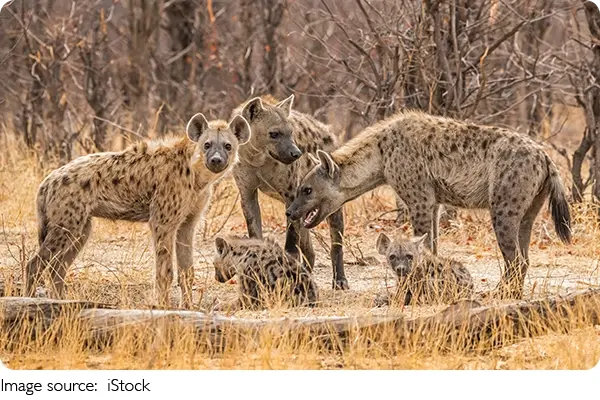
Their dominance demonstrates that mammalian societies do not follow one universal model of power. In spotted hyenas, mothers are the foundation of social rank, access to food, and family continuity. Their unusual biology supports a lifestyle in which female strength and social connections are essential, making the species one of nature's most fascinating examples of female-led society.