Giant in the Wild

Mason O'Donnell
| 25-04-2026
 · Animal Team
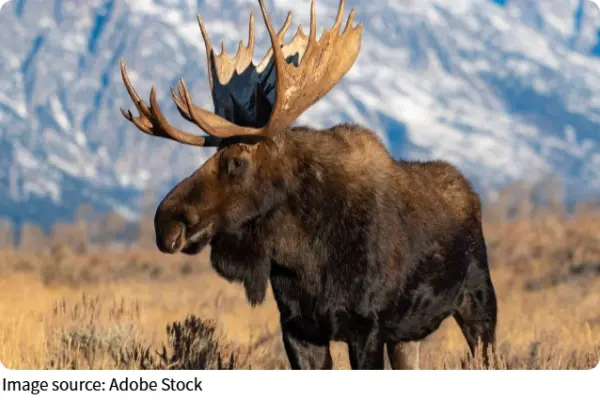
If a nature photo ever made you stop scrolling and just stare, chances are it looked something like this — a massive bull moose, antlers wide as a rocking chair, standing knee-deep in a glassy river with snow-dusted mountains stacked behind him.
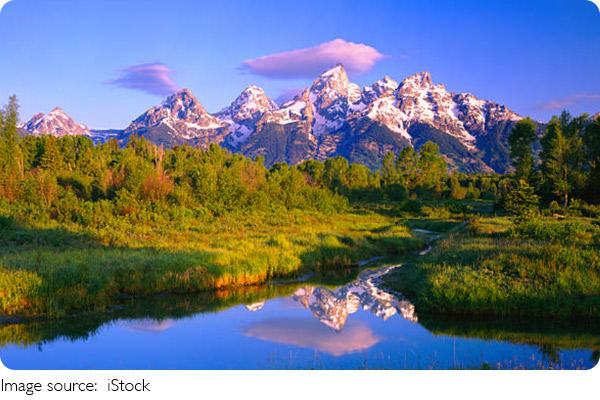
That's Grand Teton National Park in Wyoming, and honestly, no filter needed.
Meet the Moose — Nature's Gentle Giant
The moose in this shot is a bull — you can tell by those broad, palm-shaped antlers. A professional guide who has spent over a decade working in Grand Teton describes moose as animals that find a spot they like and stick to it, with relatively small migration routes. They're creatures of habit, and that's actually good news for visitors. The golden grasses, still water, and towering Teton Range in the background? That's basically their living room. Moose are especially common near ponds and lakes, as well as along the park's rivers, which makes Grand Teton one of the most reliable places in the country to spot them.
Where to Actually Find One
Don't just wander randomly and hope for luck. Look for moose in the early morning or late evening at spots like Schwabacher Landing or Oxbow Bend. You can also try driving Moose-Wilson Road and stopping at Sawmill Ponds. Oxbow Bend is one of the richest spots for wildlife, with moose wading in the wetlands and plenty of other critters dropping by at dawn and dusk. If you want a different angle, the Snake River flowing through Grand Teton is one of the best ways to see wildlife — calm scenic floats through the park offer memorable close-up encounters.
During summer months, moose often hide in the shade throughout the day and stay very close to cold streams and rivers, so early mornings are your golden window. Literally. The light is better for photos too.
Grand Teton National Park
Practical Info Before You Go
Getting there is straightforward — fly into Jackson Hole Airport (JAC), which sits right on the edge of the park. From there, you're just minutes away from the action.
Park entrance fees: A standard single-entry pass (good for 7 days) costs $35 per vehicle, $20 per person on foot or by bike, and $30 for motorcycles. An annual Grand Teton pass runs $70 per person. Note: as of the start of 2026, Grand Teton is among the parks charging an additional $100 surcharge for each non-U.S. resident entering the park, on top of the standard entry fee.
Park hours: Grand Teton National Park is open year-round, 24 hours a day. Visitor centers typically operate from around 8 AM to 5 PM, with extended hours in peak summer season.
Where to stay: Jackson, WY is the main base town, with options ranging from budget motels (around $90–$150/night) to mid-range hotels like the Rusty Parrot Lodge (from around $250/night). Inside the park, Signal Mountain Lodge and Jackson Lake Lodge offer rooms starting around $200–$350/night — pricier, but waking up to those mountain views is hard to beat. Campsite reservations inside the park run roughly $25–$35/night and can be booked through Recreation.gov.
One Rule Worth Knowing
The National Park Service recommends keeping a distance of at least 25 yards from large animals like moose, deer, and elk. They're massive and wild — beautiful from a distance, unpredictable up close. Bring binoculars, not just your phone camera.
Grand Teton is the kind of place that reminds you the natural world is still doing its thing, completely unbothered. A moose standing in a mountain river at sunrise isn't a postcard — it's Tuesday morning in Wyoming.